The book
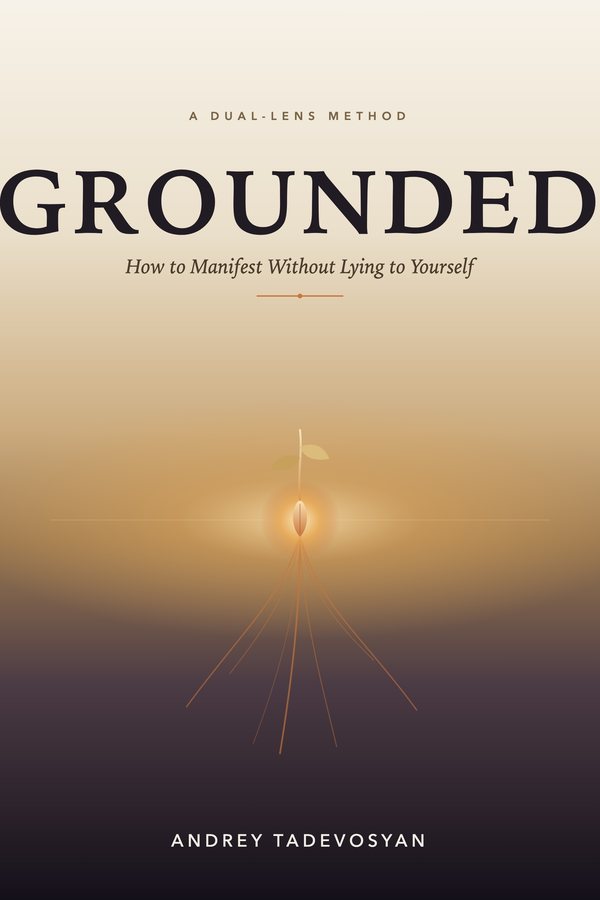
GROUNDED: How to Manifest Without Lying to Yourself
A book for people who feel the pull of manifestation and do not want to lie to themselves about it. It keeps what moves a life, labels the rest as faith, and never blames you for the gap. The first chapter is below, complete and free.
What this book is
It starts from one uncomfortable finding. In several studies, picturing an outcome as if it had already happened was followed by lower energy and, in some tasks, less effort. The book then rebuilds the practice around what research supports instead: rehearsing the steps, looking straight at the obstacle, and writing a plan for the moment it arrives.
Each chapter describes the same act twice. The psychological lens says what the practice does to attention, effort and behaviour. The contemplative lens keeps the meaning that makes people want to practise at all. Where a claim rests on evidence, the chapter names the evidence. Where it rests on faith, the chapter says so.
What it will not do
It is not a money spell and it is not a medical treatment. It works on your inner state, your behaviour and what you notice. It does not change the laws of physics or another person's free will. And it never tells you that a missed outcome means you did not believe hard enough.
What is inside
- Beyond Wishful Thinking
- The Reality Feedback Loop
- Desire, Need, and the Weight of Importance
- Problems as Preference Data
- Grounding the True Desire
- Naming It as Done: The Fulfilled Scene
- Emotional Naturalness
- Occupying the Fulfilled Identity
- The Importance Trap
- Waiting, Checking, and the Reassurance Habit
- Speech as a Mirror
- Complaining, Processing, and Real Support
- From Fighting Problems to Building Solutions
- Doing the One Thing: Action Without Magical Waiting
- Ease, Non-Resistance, and Adaptive Persistence
- Ethical Manifestation
- The Daily GROUNDED Protocol
- The 30-Day Experiment
- The 90-Day Embodiment Plan
- When the Desire Does Not Arrive
The book ends with The Technique Lab: the exercises from every chapter, gathered in one place.
Chapter 1 · Beyond Wishful Thinking
The complete first chapter, exactly as it appears in the book.
The two sales pitches you were handed
There are two stories about manifestation, and you have probably been sold both.
The first story is that desire is a kind of order slip. You picture the thing clearly enough, feel the feeling hard enough, believe without a flicker of doubt, and the world rearranges itself to hand it over. If it works, the universe delivered. If it doesn’t, some hidden doubt of yours canceled the order. Either way, you never see the gears.
The second story is that all of this is nonsense for people who won’t grow up. Vision boards are procrastination with glitter. The only thing that moves the world is work, and everything else is a comforting lie you tell yourself on the bus.
The quiet problem: neither story is true, yet you can feel that both hold something true. You have watched a clear intention change how you carried yourself into a room, and the room answered differently. You have also watched someone visualize a fortune for a decade from the same couch. Two half-truths that insult each other, and no obvious way to keep the good of each.
This book keeps the parts of manifestation that hold up and throws out the rest. To do that, we stop asking whether manifestation is real (a question too blunt to answer) and ask a sharper one: which parts of it are doing the work, and how?
Four tiers, from bedrock to faith
Most arguments about manifestation collapse because both sides point at the same word while meaning wildly different things. So let’s separate the claim into four honest tiers, from most solid to most speculative. Every technique in this book will announce which tier it lives on.
- You can change your inner state. Your attention, your reading of an event, the story you rehearse, the emotion you cultivate: all of it immediately yours to shape. Not in serious dispute.
- Your inner state changes your behavior. How you feel and what you expect steer the hundred small choices you make each day. What you attempt, what you avoid, how long you persist. This is the main engine, and it is well documented.
- Your behavior changes what you notice. Attention is selective. Once a goal is live in you, you begin to register openings that were always there and slid past before. Real, though more modest than it is usually sold.
- Your inner state directly commands external events, bypassing your behavior. Rain on request. A stranger’s decision. A lottery number. This tier is faith, or metaphysics. It gets treated here with respect and held lightly, never sold as a mechanism, never used to explain away a disappointment.
The supernatural-certainty story fails by treating tier four as if it were as reliable as tier one. The dismissive story fails by throwing out tiers one through three, the actual working machinery of a changed life, along with tier four. The whole art is to work the first three with real skill and hold the fourth with an honest, open hand.
The dual lens: two true descriptions of the same act
To do that honestly, we look at every practice through two lenses at once, and never let them blur.
The spiritual lens speaks the language of imagination, faith, meaning, identity, intention, surrender, and service. It carries the why of the whole enterprise: the felt sense that your life is yours to author. This lens is old and powerful, and this book treats it that way.
The psychological lens speaks the language of attention, mental rehearsal, self-efficacy, expectancy, reappraisal, and identity-based habit. It describes the same act in terms of what is observably happening.
One discipline sets this book apart. When a claim is metaphysical, we say so plainly and don’t dress it in the borrowed lab coat of science. When a claim is evidenced, we name the evidence rather than gesture at “studies show.” The two lenses describe the same practice the way a poem and a wiring diagram can describe the same lamp. Both are honest. Neither is the other. Trouble begins only when someone sells you the poem as the diagram.
You may have heard, for instance, that you must “raise your vibration” to attract what you want. Treat that strictly as metaphor, flagged here as poetry rather than physics. What actually moves is your state and your bearing, and how others respond to them. The metaphor points at something real; it just isn’t a radio.
An old idea, recently distorted
Manifestation’s root instinct is ancient, and at the root it was more honest than its current packaging. The oldest and cleanest version is the Bhagavad Gita’s nishkama karma: act with full commitment, then release your attachment to the fruits (around 2.47). Act, then let go. That is the ancestor of everything this book says about not clenching. The Stoics drew the same line; Epictetus separated what is up to us from what is not. Centuries later William James described the “as if” principle, the observation that acting as though a trait were already yours can help call it forth. Behavior, in other words, with no sorcery about it.
The strand most people mean by “manifestation” runs through the early-twentieth-century New Thought writers: James Allen’s As a Man Thinketh (1903), Wallace Wattles’s The Science of Getting Rich (1910), and later Neville Goddard, who taught assuming the feeling of the wish fulfilled (Feeling Is the Secret, 1944). These are spiritual teachings, attributed and dated, offered for their lineage rather than as proven mechanisms. What changed recently is the promise. Popularizations such as The Secret (2006) kept the vivid imagining and deleted the discipline: the acting, the releasing, the honest limits. This book is a restoration of the older honesty.
What the mind actually does with a picture of the future
Buried in the psychological lens is an uncomfortable gift, and it sits at the center of this book. You’d think that vividly imagining your wish already fulfilled (the money in the account, the applause, the wedding) would be the engine of achievement. The research points the other way. Kappes and Oettingen have shown that fantasizing the desired outcome as already achieved tends to lower effort and achievement rather than raise it. The mind, tasting the reward in imagination, relaxes as if some of the work were already banked. You feel wonderful and you do less. The daydream spends the fuel it was supposed to store.
So the object of your imagination matters enormously. Pham and Taylor found that people who mentally rehearsed the process, the concrete steps of getting there, outperformed those who pictured only the glorious end, partly because the rehearsal produced more planning and less anxiety. And Oettingen’s work on mental contrasting suggests that pairing a wish with a clear-eyed look at the obstacle, then a plan, tends to do better than sunny positive thinking. The advantage is modest rather than dramatic, and it is largest when the goal is realistic for you; when it is not, contrasting tends to make that plain, which is its own kind of help.
Those findings are the spine of this book. Imagination is not the problem; outcome fantasy standing in for action is. Used to rehearse who you are being and what you will do, imagination becomes one of your most practical tools.
The GROUNDED map
Everything in this book hangs on a single cycle of eight movements, spelling the word GROUNDED. It loops rather than climbs; expect to re-enter it many times, and rarely in a straight line.
- G. Ground the desire. Get honest about what you actually, intrinsically want, and strip out the goals you inherited, borrowed for status, or chose to avoid something.
- R. Reframe the problem. Turn an unwanted condition into clear preference-data and a concrete goal, without pretending the problem isn’t real.
- O. Occupy the identity. Begin living the standards, routines, and boundaries of the fulfilled version of you: identity expressed as habit.
- U. Unclench. Lower the desperate importance around the goal, so fear stops degrading your judgment.
- N. Name it as done. Use a short, natural, fulfilled scene: imagination in service of who you’re being, never a substitute for doing.
- D. Do the one thing. Take one concrete, ethical, solution-directed action, wired so it actually fires.
- E. Ease the grip. Stop compulsive checking and let incubation work.
- D. Discern and adapt. Read the evidence without obsession; decide when to hold, revise, or release.
Notice the order, because it is deliberate and it is the book’s signature. The imagining step, N, comes after you occupy the identity, unclench, and start doing. Outcome-imagery before action tends to de-energize you (Kappes and Oettingen again), so the daydream doesn’t get to lead. In GROUNDED, imagination serves behavior and never replaces it. If you keep only one structural idea from this book, keep that one.
The Two-Column Read
Here’s a small tool you can use on any manifestation claim you meet, including the ones in this book. The Two-Column Read has one job: keep the two lenses from blurring.
Draw a line down a page. On the left, write the claim in its poetic form, exactly as it was told to you. On the right, translate it into the plainest mechanism you can find on tiers one through three. If the right column comes up empty, you’ve found a tier-four claim, and you can decide, consciously, how much faith to lend it. Nothing gets debunked in the process. You’re just refusing to be confused.
| Spiritual claim (as told) | Plain mechanism (what may really be happening) |
|---|---|
| “Act as if it has already happened.” | Living the identity changes your standards and choices now; behaving as the person you intend to be builds real evidence and skill. |
| “Ask, believe, receive — and it comes.” | Belief here means expectancy; it raises effort, persistence, and your willingness to notice and seize openings (tiers 1–3). The passive “it comes” part is tier 4, held lightly. |
| “Speak it into existence.” | Your habitual language is a read-out of, and a nudge to, your habitual thought; changing it can shift mood and behavior. There’s no spell in it that edits reality. |
| “Raise your vibration to attract it.” | A calmer, warmer state changes how you carry yourself, and people respond to that. Metaphor, not physics. |
Cynicism has nothing to do with this. The poetry keeps its dignity, because it is often pointing at something real. The right column keeps you honest about why a practice works, so a claim with no right column can’t fool you, and a strong one becomes something you use deliberately instead of merely hoping about.
Daniel and the number on the mirror (Composite)
Consider Daniel, a composite drawn from many common patterns rather than any one person. He wanted more money and had spent months on the supernatural-certainty version: a number on his mirror, a nightly fantasy of the fatter balance, a warm glow, and (the part he told no one) the 4 p.m. trips to the office bathroom, thumb refreshing the banking app, that hot prickle of a grown man waiting on a number that never moved.
Run his practice through the Two-Column Read and the trouble is obvious. His nightly ritual lived entirely in outcome fantasy, precisely the thing shown to sap energy. The glow was real; the raise was tier four, treated as tier one. His left column was full. His right column was empty.
The grounded version kept the parts with an honest right column and changed the rest. He named the true desire under the number: not “wealth” in the abstract but security and a little more room in his week (G). He began occupying the identity of someone who is paid well: tracking his results, speaking about his work without apology, holding a boundary on scope creep (O). He lowered the pressure so one conversation stopped feeling like a verdict on his worth (U). His imagining shrank to a short, calm scene of handling the salary conversation with steadiness, a rehearsal of being that person rather than a fantasy of the confetti (N). And he wired one concrete action: if it is Thursday, then I book the meeting and bring my results page (D).
Does Daniel get that exact raise on that exact timeline? No promises, and this book will never pretend otherwise; his manager, the budget, and plain luck all get a vote. What changed with near-certainty were tiers one through three: his state, his behavior, and what he noticed. That is the honest promise, and it is large enough.
“So it’s just psychology in a robe?”
A fair reader will have grown suspicious by now and will put it bluntly: If every spiritual claim just cashes out as a psychological mechanism, why keep the spiritual language at all? Isn’t this cognitive-behavioral therapy in ceremonial dress? Why not say the science and drop the incense? Right challenge. It deserves a straight answer.
Why the incense stays
Two things are true at once, and the honesty of this book depends on holding both.
First, no metaphysics is being smuggled past you. Where a practice works through an observable mechanism, we show you the mechanism and refuse to inflate it into cosmic law. Much of what has been sold as magic turns out, on inspection, to be the ordinary and remarkable machinery of attention, expectancy, identity, and action. Naming that plainly is a feature of this book, whatever it costs in mystique.
Second, try stripping the spiritual lens away and see what you lose. A wiring diagram tells you how the lamp works, and nothing about why you would want light. The language of meaning, faith, and service is what makes a person pick the practice up on the gray Tuesday when no mechanism is motivating enough on its own. And tier four remains an open frontier, where honest people can hold humble faith without pretending it is settled science. We keep the spiritual lens because it carries the why, and because honesty means overclaiming in neither direction: faith never dressed up as data, a meaningful life never flattened into a parts list.
Misuse to Avoid
Do not use the dual lens to quietly collapse into one side.
- Do not weaponize the psychological column to sneer every spiritual practice out of existence. “It’s only attention” is as dishonest as “it’s pure magic.” The point is respect for both, and victory for neither.
- Do not use the spiritual column to escape action. “I’m doing the inner work” will not cover for the one concrete thing in the D movement. Inner state without behavior is exactly the trap the research warns about.
- Do not read this chapter as a guarantee. Working tiers one through three well genuinely changes your life; it does not entitle you to a specific outcome on a specific date, and any book that promises that is lying to you.
- Never conclude that a disappointment means you “didn’t believe hard enough.” That sentence is banned from this book. Belief is not a payment you failed to make.
Reflection questions
- Of the two sales pitches, supernatural certainty and total dismissal, which one did you absorb more deeply, and what did it cost you?
- Think of a manifestation claim you currently hold. Which of the four tiers is it really living on? Were you treating a tier-four hope as a tier-one certainty?
- When your own past attempts “failed,” how much of that story blamed your belief, versus examining your behavior and your circumstances? And where is the spiritual why strong in your life while the concrete action is missing?
Exercise: your first Two-Column Read
Take one belief you carry about how good things come to you, spoken in your own words, however poetic. Write it in a left column exactly as you would say it. Then, in the right column, write the plainest honest mechanism you can find on tiers one through three. If the right column stays empty, mark the belief as tier four and decide, consciously and without shame, how much faith you want to lend it. That is a legitimate choice. Nobody failed.
A guardrail for the anxious, the over-analyzer, and the compulsive checker: the aim here is a single calm pass, no interrogation of your entire mind required. Do one belief and stop. If translating a cherished belief into a mechanism feels deflating rather than clarifying, keep the poetry; the exercise is meant to end confusion, never to strip meaning out of your life. And if this stirs real distress, close the notebook. Nothing here is urgent, and no insight is worth spiraling for.
The frame, before the engine
Neither sales pitch survives this chapter. What’s left is a set of practices, most of them working through the solid, observable tiers of inner state, behavior, and attention, one of them touching the open frontier of faith. The dual lens keeps poetry and mechanism in separate, honest hands. The four tiers tell you which promise you are being made. And the GROUNDED map places imagination after action, because outcome fantasy before action tends to drain you. You have the frame. You do not yet have the engine.
Next: the engine
That engine is a loop, and before you can work any of the eight movements with skill you need to see it plainly: the one that turns an inner state into an outer result, the honest machinery behind “you get more of what you focus on.” That is where we go next.
Questions before you buy
What format is it?
EPUB, the standard ebook format. It opens in Apple Books, Google Play Books, Kobo and most other ebook apps. For a Kindle, use Amazon's Send to Kindle and choose the file.
Do I need an account?
No. Checkout is handled by Stripe. You give an email address so the download link has somewhere to go, and that is all.
Is this the same as GROUNDED PRO?
No. GROUNDED PRO is an upgrade inside the free app. The book is a separate thing you read. Neither one needs the other, and the thirty-day app stays free.
What if the link does not arrive?
It usually arrives within a few minutes. Check your spam or promotions folder first. If it is not there, email hello@ismanifestationreal.com from the address you used at checkout, and the file will be sent by hand.
Sources for chapter 1
- Kappes & Oettingen, “Positive fantasies about idealized futures sap energy,” Journal of Experimental Social Psychology, 2011. The outcome-fantasy finding.
- Pham & Taylor, “From thought to action: effects of process- versus outcome-based mental simulations on performance,” Personality and Social Psychology Bulletin, 1999. Rehearsing the steps against picturing the result.
- Wang, Wang & Gai, “A meta-analysis of the effects of mental contrasting with implementation intentions on goal attainment,” Frontiers in Psychology, 2021. Pooled results for pairing a wish with its obstacle and a plan.
The chapter also names James Allen, Wallace Wattles, Neville Goddard and The Secret. They appear as dated spiritual teachings, not as evidence. Every study this site cites is graded on the sources page.
Put an idea into practice
Choose a concrete action in the free Practice Studio, or keep observations in the Experience notebook. A personal record can guide reflection; it does not by itself establish a cause.